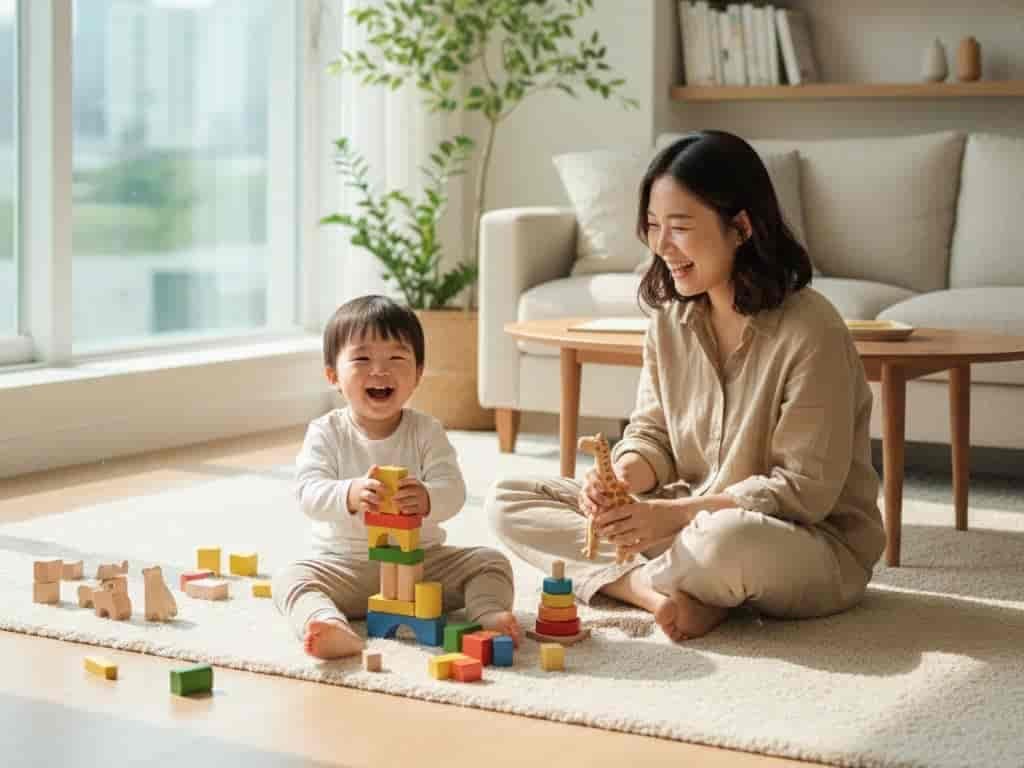
Toddlers are naturally curious. They want to touch everything, open every drawer, carry objects from one room to another, and discover what happens when they pour, stack, drop, or squeeze something. While this curiosity is an important part of early learning, keeping a toddler happily occupied at home can sometimes feel like a full-time job.
If you have ever finished preparing lunch only to find your toddler pulling cushions off the sofa, asking for your phone, or following you from room to room, you are certainly not alone. Many parents look for easy ways to keep their little ones engaged without relying on cartoons, mobile games, or television throughout the day.
The good news is that you do not need expensive toys, elaborate crafts, or a professionally designed playroom to create meaningful play experiences. Some of the most enjoyable screen-free activities for toddlers use simple household items, everyday routines, and a little imagination.
From water play and building blocks to pretend shops, sorting games, and homemade obstacle courses, there are plenty of ways to encourage your toddler to explore, move, create, and learn at home.
In this guide, we will explore 15 practical screen-free activities for toddlers that parents and caregivers can try at home. You will discover what you need, how to set up each activity, which skills it may encourage, how to adapt it for different ages, and how to make playtime easier on busy days.
Whether you are looking for indoor activities for toddlers on a rainy afternoon, screen-free activities for a working parent’s busy day, or simple toddler activities that do not require buying new toys, these ideas can help you build a more engaging daily routine.
Why Screen-Free Activities Matter for Toddlers
Screens are part of modern family life. Parents use phones to communicate, television to relax, and digital tools to manage everyday responsibilities. The goal is not to make every family screen-free or to suggest that parents should never use a device. Instead, it is to create opportunities for young children to experience the real world through movement, conversation, play, and hands-on exploration.
During toddlerhood, children are rapidly developing their language, coordination, social understanding, problem-solving abilities, and independence. Everyday play provides opportunities to practise these skills in ways that are appropriate for their stage of development.
For example, when a toddler places large blocks on top of one another, they experiment with balance and learn what happens when a structure becomes unstable. When they pretend to feed a doll, they practise imitation and symbolic play. When they help put socks into a laundry basket, they experience sorting, matching, and following simple instructions.
These experiences do not need to look educational to be valuable. Children learn while they are having fun, exploring, repeating actions, and interacting with caring adults.
1. Hands-On Play Encourages Exploration
Toddlers learn by interacting with objects and people. They may enjoy feeling different textures, watching objects move, hearing sounds, and experimenting with how things fit together.
Simple activities such as stacking blocks, transferring large objects between containers, or exploring washable crayons allow children to investigate cause and effect. They can try an idea, observe the result, and try again.
You do not need to explain every lesson. Sometimes, the most helpful response is to watch your child explore and offer a few words about what is happening.
For example, you might say, “You put the big block on the bottom,” or “The ball rolled under the table.” These small comments introduce useful vocabulary without turning playtime into a formal lesson.
2. Play Creates Opportunities for Language Development
A toddler may not yet be able to explain what they are doing, but they are constantly learning from the words they hear.
During screen-free play, parents can name objects, describe actions, ask simple questions, and respond to gestures or early words.
If your child is playing with toy animals, you might say, “The cow is walking,” “The dog is sleeping,” or “Where is the little cat?” You can also pause to give your toddler time to respond in their own way.
A response does not always need to be a complete sentence. Pointing, making a sound, looking toward an object, or using one word can all be meaningful forms of communication.
Follow your child’s interest rather than asking a long series of questions. Warm conversation during ordinary activities can be more enjoyable than repeatedly testing your toddler on colours, shapes, or animal names.
3. Movement Helps Toddlers Use Their Energy
Toddlers generally need plenty of opportunities to move throughout the day. Indoor movement games can be especially useful when the weather is poor, outdoor space is limited, or a family cannot easily visit a playground.
Dancing, walking along a clear path, kicking a soft ball, and stepping over low cushions can provide opportunities to practise coordination and body awareness.
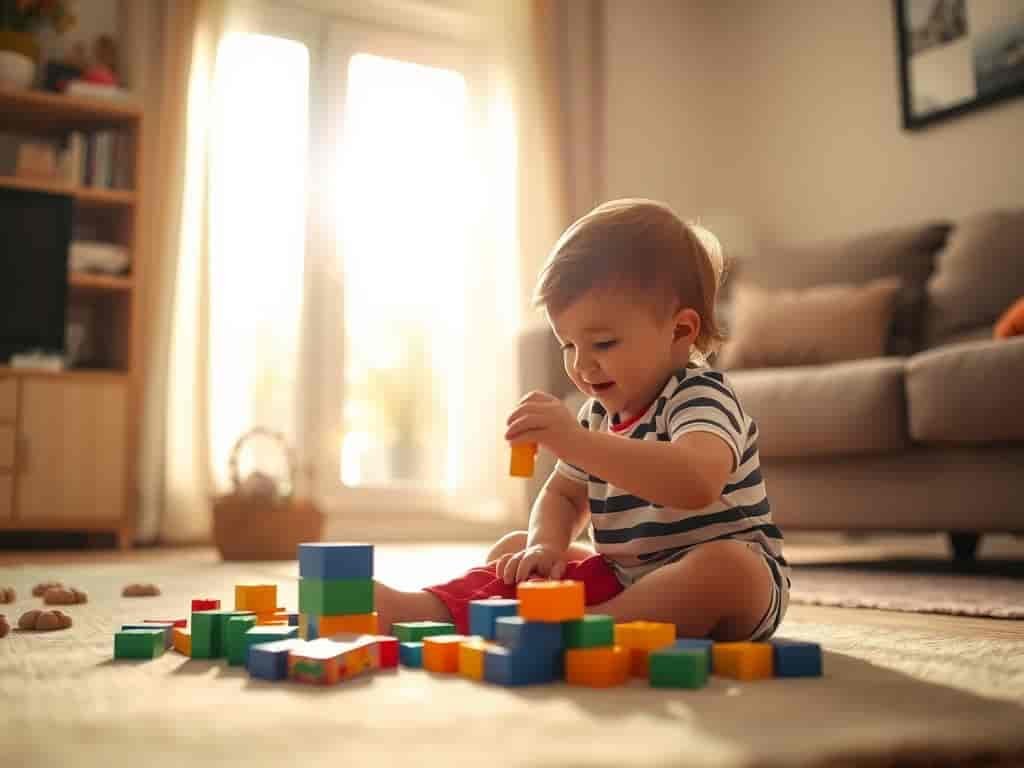
Movement activities should match your child’s abilities and take place in a safe space. Remove sharp objects, secure furniture where appropriate, and avoid slippery surfaces, unstable climbing structures, and high jumps.
4. Independent Play Can Develop Gradually
Many parents search for activities that will keep a toddler busy independently while they prepare meals, complete household chores, or work from home.
Independent play can be encouraged, but expectations should be realistic. A young toddler may want frequent reassurance and interaction. Another child may happily explore a favourite toy for a short period before seeking company.
The goal is not to make your toddler play alone for an extended time. Instead, offer an interesting, age-appropriate activity, stay close enough to supervise, and gradually give your child opportunities to make choices and explore.
Some days, your toddler may play independently for several minutes. On other days, they may want you beside them throughout the activity. Both experiences can be normal.
5. Screen-Free Play Can Make Family Time More Interactive
Parents do not need to lead every game or entertain their children continuously. However, sharing a few minutes of attention can make ordinary activities more enjoyable.
You might build a tower together, sing while putting toys away, or let your toddler help wash vegetables before dinner. These small moments allow children to participate in family life and experience positive interaction.
If you need to use a screen for work or practical reasons, there is no need to feel guilty. Think of screen-free activities as additional opportunities for connection, exploration, and movement rather than another standard you must meet perfectly.
15 Screen-Free Activities for Toddlers That Keep Them Busy at Home
The following activities are designed to be simple, flexible, and affordable. Most can be prepared with objects you already own, although some require a little planning and close adult supervision.
Choose activities according to your child’s age, abilities, interests, and safety needs. Every toddler develops at their own pace, so an activity that delights one child may not interest another.
Activity 1: Build a Tower With Large Blocks
Best for: Toddlers who enjoy stacking, knocking things down, and building.
What you need:
- Large, age-appropriate building blocks
- A clear area on the floor
- A low, stable surface if your child prefers building on a table
Building towers is one of the simplest indoor activities for toddlers, and it can be repeated in many different ways. Your child can stack blocks, arrange them in a line, build a pretend house, or knock down a tower and begin again.
Start by placing a few large blocks in front of your toddler. Build a short tower yourself, then invite your child to add another block. If they prefer knocking the tower over, allow them to explore that idea in a safe space.
You can introduce new challenges gradually. Ask your toddler to find a block of a particular colour, place a larger block underneath a smaller one, or help build a road for toy cars.
Avoid turning the activity into a competition. A tower that falls down is not a failure; it is an opportunity to try again.
What your toddler may learn
Building with blocks provides opportunities to practise hand-eye coordination, spatial awareness, problem-solving, and patience. Children also begin exploring concepts such as tall and short, up and down, more and less, and big and small.
You can encourage language by describing what your child is doing: “Your tower is getting taller,” or “Let’s put the wide block at the bottom.”
How to make it more interesting
Try building a garage for toy vehicles, a pretend animal enclosure, or a little house for dolls. You can also build a tower together and take turns adding one block at a time.
For younger toddlers, use large blocks specifically designed for their age. Small building pieces can be choking hazards, particularly for children who still put objects in their mouths.
Parent tip: Keep a small basket of building blocks accessible and rotate them with other toys. You do not need to put every toy out at once.
Activity 2: Create a Safe Water-Play Station
Best for: Toddlers who enjoy splashing, pouring, and exploring textures.
What you need:
- A shallow basin
- A small amount of water
- Large plastic cups
- Large, toddler-safe scoops or containers
- A towel for spills
Water play can be fascinating for toddlers. They may enjoy watching water move between containers, making gentle splashes, or discovering that an empty cup behaves differently from a full one.
Place a shallow basin on the floor or another stable surface where you can supervise closely. Add only a small amount of water and offer a few large, unbreakable containers.
Show your child how to pour water from one cup into another. Let them explore at their own pace while you describe what they are doing.
You might say, “The cup is full,” “Now the water is going into the bowl,” or “You poured slowly.” These simple observations make the activity interactive without interrupting your toddler’s exploration.
What your toddler may learn
Water play introduces early ideas about volume, movement, cause and effect, and simple problem-solving. It can also provide sensory exploration through the feeling and sound of moving water.
How to make it more interesting
On a warm day, you could offer large plastic bath toys or a large sponge that your toddler can squeeze over the basin. You can also ask your child to move water between two large containers with a toddler-safe cup.
Keep the activity short and stop if your toddler becomes frustrated or loses interest.
Important safety note: Water presents a drowning risk even when it is very shallow. An adult must remain within arm’s reach and actively supervise the child throughout the activity. Never leave a toddler alone near a basin, bucket, bathtub, toilet, or other container of water, even briefly. Empty the basin immediately when playtime ends.
Do not use small objects, slippery surfaces, or electrical devices near the water.
Activity 3: Explore Colours With Washable Crayons
Best for: Toddlers who enjoy drawing, scribbling, and making marks.
What you need:
- Large, non-toxic crayons designed for toddlers
- Plain paper
- A washable surface or protective mat
You do not need to teach your toddler how to draw recognisable pictures. At this age, making marks, choosing colours, and exploring how a crayon moves across paper can be enjoyable experiences on their own.
Place a large sheet of paper on a stable table or the floor. Offer two or three suitable crayons and let your toddler experiment.
Some children will make long lines. Others may create circles, dots, or a collection of marks in one corner. You can draw alongside them, but avoid insisting that they copy a particular shape.
Describe what you see. For example, “You made a long blue line,” or “You are moving the crayon around and around.”
What your toddler may learn
Drawing offers opportunities to practise grip, hand control, visual attention, and early mark-making skills. It also allows children to make choices and express themselves without needing to use words.
How to make it more interesting
Try drawing a simple road for toy cars, making large dots that your toddler can colour over, or creating a picture together. You can also use paper to make a pretend birthday card for a family member.
Avoid using tiny crayons, loose pencil parts, markers with removable caps, or art materials that are not intended for young children. Supervise closely and keep art supplies away from your toddler’s mouth.
Parent tip: Put away the crayons when your child starts chewing them or drawing on unsuitable surfaces. A short, successful activity is better than a long session that becomes stressful.
Activity 4: Have a Pretend Tea Party
Best for: Toddlers who enjoy imitation and make-believe.
What you need:
- A sturdy toy tea set, if available
- Large, unbreakable cups and bowls
- A favourite doll or stuffed toy
- A small blanket or cloth
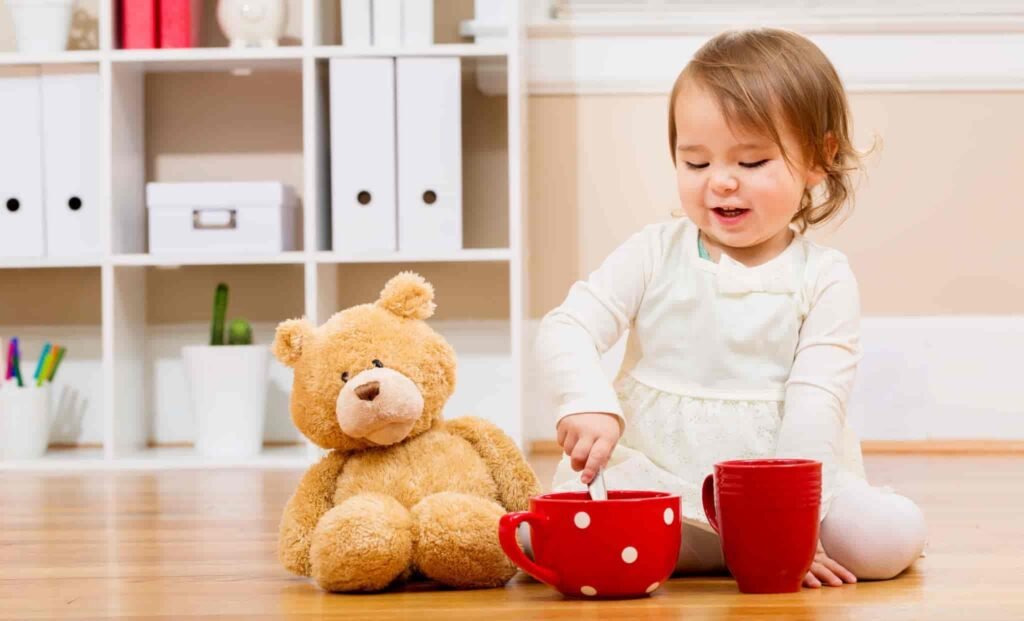
Pretend play allows toddlers to recreate familiar experiences. They may imitate the way adults prepare meals, serve drinks, welcome guests, or sit together at a table.
Arrange a few toy cups and bowls on a low table or clear floor space. Invite your toddler to prepare tea for you, serve a meal to a stuffed animal, or invite their toys to a pretend party.
You can follow your child’s ideas rather than creating a fixed story. If your toddler decides that a toy bear is hungry or that the doll needs to go to sleep, respond to the story they are developing.
What your toddler may learn
Pretend play provides opportunities to practise language, imitation, social interaction, sequencing, and early symbolic thinking. It can also help children explore familiar routines in a playful way.
How to make it more interesting
Give each stuffed animal a role. One toy might be the guest, another the cook, and another the person who needs help finding a seat.
You can also introduce simple phrases such as “Would you like some tea?” or “Let’s give the bear a cup.” Let your toddler respond through gestures, sounds, or words.
Use only safe, age-appropriate play materials. Avoid real hot drinks, glass cups, small pretend food pieces, and accessories that can detach and become choking hazards.
Parent tip: You do not need to buy a complete toy tea set. Large plastic cups and bowls can be enough for supervised pretend play.
Activity 5: Sort Laundry Together
Best for: Toddlers who like helping adults with everyday tasks.
What you need:
- A small basket of clean laundry
- A clear space on the floor
- A few large, easy-to-handle clothing items
Household chores can become playful learning opportunities when children are invited to participate safely. Sorting laundry is a practical activity that uses familiar objects and gives your toddler a simple role.
Sit with your child and offer a small selection of clean clothing, such as large T-shirts, trousers, or towels. Invite them to place the items into a basket or help match two similar socks.
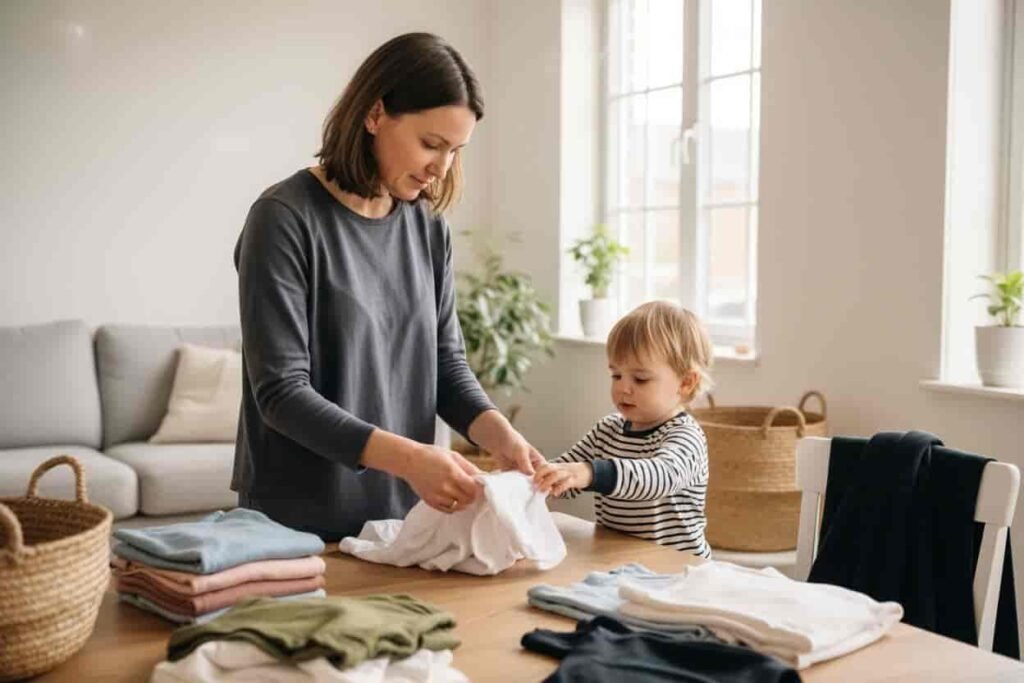
You can also ask your toddler to find a particular item: “Can you find the blue shirt?” or “Let’s put the towels together.”
If your child puts everything into the same basket, that is perfectly fine. The purpose is participation, not perfect sorting.
What your toddler may learn
This activity introduces matching, categorising, following simple instructions, and using new vocabulary. It may also help your toddler feel included in everyday family routines.
How to make it more interesting
Make a game of finding pairs of large socks or putting towels into a separate basket. You can count a few items together if your toddler enjoys counting, but there is no need to expect accurate numbers.
Never let a toddler play inside a washing machine or dryer. Keep laundry detergent, pods, cleaning chemicals, cords, and small clothing accessories out of reach. Supervise around laundry equipment and do not allow climbing on baskets or appliances.
Parent tip: Involving your toddler in small chores can be more practical than trying to keep them occupied with a separate activity while you work.
Activity 6: Make a Cushion Path on the Floor
Best for: Toddlers who enjoy walking, stepping, and moving around.
What you need:
- A few firm cushions placed directly on the floor
- A clear, uncluttered area
- A soft toy or favourite object to use as a destination
When toddlers have been indoors for a long time, a simple movement game can help them use their energy.
Place a few firm cushions on a clear floor, ensuring that they do not slide or create high steps. Invite your toddler to walk around the cushions, step over a low obstacle, or follow a simple path toward a stuffed animal.
For younger or less confident walkers, keep the route flat and straightforward. They may enjoy walking between two cushions or following a line made with a strip of paper that is securely positioned and cannot slip.
What your toddler may learn
Movement games offer opportunities to practise balance, coordination, body awareness, and following simple directions.
You can use words such as “around,” “over,” “beside,” and “stop” while your toddler moves.
How to make it more interesting
Pretend the cushions are stepping stones across a river, or ask your toddler to deliver a toy to the other side of the room. Keep the story simple and let your child decide whether they want to participate.
Do not use furniture, high sofas, unstable stools, or stacked cushions as climbing equipment. Remove sharp objects and supervise closely. Stop if the floor becomes slippery or your child begins jumping from heights.
Parent tip: A few minutes of safe movement can be enough to break up a quiet indoor afternoon. You do not need to create a complicated obstacle course.
Activity 7: Read a Picture Book Together
Best for: All toddlers, including children who have short attention spans.
What you need:
- One or two sturdy picture books
- A comfortable place to sit
Reading together is one of the easiest screen-free activities for toddlers because it can fit into almost any part of the day.
Choose a book with clear pictures, simple language, familiar objects, or a story your child enjoys. Sit beside your toddler and allow them to point at pictures, turn pages, repeat favourite words, or move between pages.
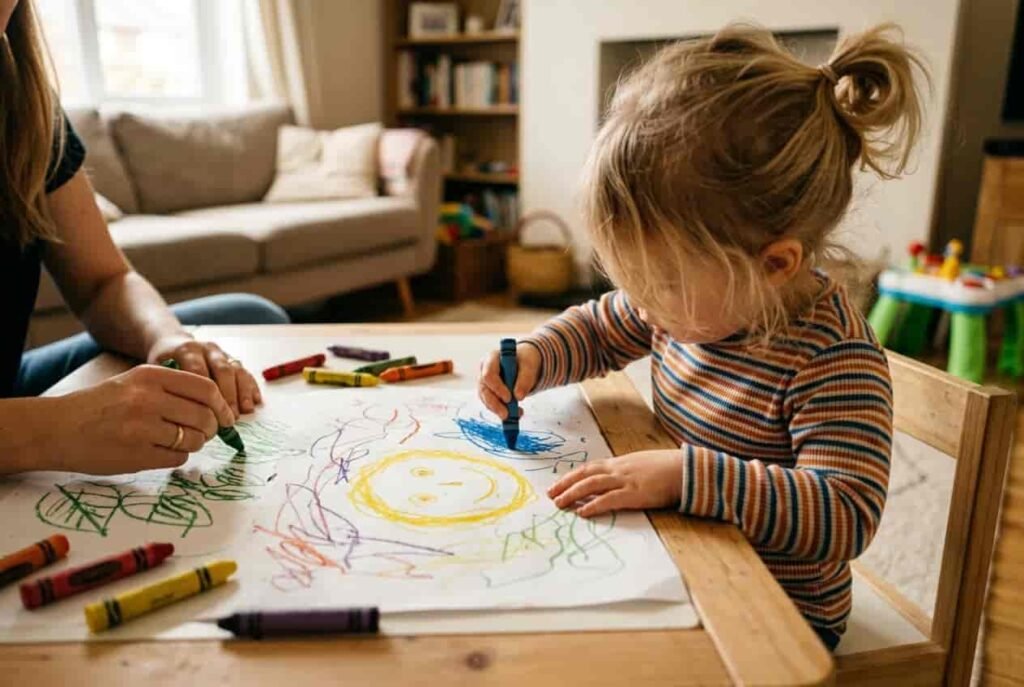
You do not need to read every word. If your child points to a dog, you might say, “Yes, that’s a dog. The dog is running.” If they turn back to a favourite page several times, follow their interest.
What your toddler may learn
Shared reading provides opportunities to hear language, connect words with pictures, develop attention, and enjoy positive interaction with a caregiver.
It can also introduce emotions, routines, animals, vehicles, colours, and everyday experiences.
How to make it more interesting
Choose a book about bedtime, animals, food, or visiting the park. Invite your toddler to make an animal sound or find a familiar object on the page.
You can also tell a short story using family photographs, provided you handle the device or printed photographs safely and keep the focus on shared conversation rather than turning the activity into screen time.
If your toddler wanders away, do not assume that the activity has failed. Young children often listen for a short time, explore something else, and return later.
Parent tip: Keep a small basket of sturdy books where your toddler can reach them safely. Familiar favourites are often just as valuable as new books.
Activity 8: Create a Toy Animal Rescue Game
Best for: Toddlers who enjoy animals and imaginative play.
What you need:
- A few large, age-appropriate toy animals
- A clear floor space
- A large open box or basket
Turn ordinary toy animals into characters in a simple pretend adventure.
Place a few large toy animals around a safe play area. Tell your toddler that the animals need help finding their home, crossing a pretend road, or returning to a basket.
For example, you might say, “The elephant is looking for its home. Can we help?” Your toddler can carry the elephant to the basket, place the animals together, or make their own story.
You can keep the game very simple. A toddler may be satisfied with moving one animal back and forth, while an older toddler may invent a more elaborate story.
What your toddler may learn
This activity encourages pretend play, language, categorisation, and problem-solving. It can also introduce early concepts such as near and far, inside and outside, and together and apart.
How to make it more interesting
Create a pretend animal hospital or a feeding station using large toy accessories. Your toddler can decide which animal needs help or which one should go home first.
Avoid miniature animals or accessories if your child still mouths objects. Inspect toys for loose parts, broken edges, and pieces that could detach.
Parent tip: You can use large stuffed animals instead of plastic toys. The best materials are those your child can handle safely and already enjoys.
Activity 9: Make a Simple Indoor Treasure Hunt
Best for: Toddlers who enjoy searching, finding, and carrying objects.
What you need:
- A few familiar, safe toys
- A basket or box
- A clear room with no hidden hazards
A treasure hunt does not need complicated clues. For a toddler, the excitement often comes from finding a favourite object and carrying it to a special place.
Choose three or four large toys and place them in obvious, safe locations around one room. For example, you might put a stuffed animal beside a chair, a large ball on the floor, and a toy vehicle near a basket.
Invite your toddler to find the toys and bring them back to you. Use simple clues such as “Can you find the teddy?” or “Let’s look beside the chair.”
For younger toddlers, point toward the object or allow them to see part of it. Older toddlers may enjoy searching with less help.
What your toddler may learn
A treasure hunt provides opportunities to practise observation, memory, movement, listening, and following simple directions.
It can also introduce spatial words such as under, beside, behind, and inside.
How to make it more interesting
Choose a theme. You could search for animals, large vehicles, or favourite soft toys. You might also ask your child to find one object and then choose the next toy to hide.
Keep all objects visible or placed in safe, accessible locations. Never hide items near stairs, electrical outlets, hot appliances, medicines, cleaning products, or other hazardous areas.
Do not use coins, buttons, marbles, small toy parts, or food pieces as treasure.
Parent tip: Start with only a few objects. A simple search can be more enjoyable than a complicated game that requires constant instructions.
Activity 10: Play With Large Cardboard Boxes
Best for: Toddlers who enjoy exploring spaces and pretending.
What you need:
- A clean, sturdy cardboard box
- Non-toxic, age-appropriate crayons if decorating
- A clear area on the floor
Before throwing away a large delivery box, consider whether it can be used for supervised play.
A sturdy box can become a pretend car, a house for stuffed animals, a shop counter, or a place to put large toys. You can draw simple windows or doors on the outside and invite your toddler to decorate it with washable crayons.
Let your child decide how the box should be used. They may prefer putting toys inside and taking them out repeatedly rather than following your pretend-play idea.
What your toddler may learn
Box play offers opportunities to explore space, object permanence, imagination, language, and simple problem-solving.
Putting an object inside and taking it out again can be especially interesting for younger toddlers. Older toddlers may begin assigning roles to the box, such as a bus or a shop.
How to make it more interesting
Turn the box into a pretend post office. Your toddler can place large toy packages inside and deliver them to a stuffed animal.
You could also make a simple pretend garage for large toy vehicles.
Remove staples, packing straps, sharp edges, plastic film, and loose packing materials before use. Avoid boxes that could collapse, trap your child, or encourage climbing. Do not let your toddler climb on top of a box or play with plastic bags.
Parent tip: You do not need to decorate the box perfectly. A plain box can be more than enough for imaginative play.
Activity 11: Help Prepare a Simple Snack
Best for: Toddlers who like watching and copying adults.
What you need:
- A clean, stable work surface
- A few age-appropriate ingredients
- A small bowl or plate
- An adult who can supervise every step
Many toddlers are interested in what happens in the kitchen. Rather than trying to keep your child away from every food-preparation activity, you can sometimes give them a simple, safe role.
For example, your toddler might help place washed, soft food pieces into a bowl, move large pieces of fruit from one container to another, or carry a lightweight, unbreakable plate to the table with your assistance.
Choose tasks that do not involve knives, heat, electrical appliances, raw animal products, or other hazards. The adult should handle cutting, cooking, and any preparation that requires sharp tools.
What your toddler may learn
Kitchen participation provides opportunities to explore new vocabulary, follow simple directions, observe everyday routines, and become familiar with foods.
Children may also become more interested in a meal when they have had an opportunity to see how it is prepared. However, helping prepare food does not guarantee that a toddler will eat it, and that is okay.
How to make it more interesting
Invite your toddler to help assemble a simple snack with suitable ingredients. You might offer soft banana pieces prepared by an adult, plain yoghurt in a bowl, or other foods appropriate for your child’s age and eating abilities.
If you need more food inspiration, you can naturally link to your MyBabyShaby.com guide on Healthy Snacks for Toddlers. Your article about Healthy Smoothies for Toddlers may also be helpful for parents looking for more nutritious options.
Always supervise eating closely. Prepare foods in forms appropriate for your child’s developmental stage, and avoid common choking hazards such as whole grapes, whole nuts, popcorn, hard raw vegetable pieces, and spoonfuls of thick nut butter. Never leave your toddler alone while eating.
Parent tip: Keep the task short. Your toddler can participate for a minute or two without needing to complete the entire meal preparation.
Activity 12: Enjoy a Music and Movement Break
Best for: Toddlers who enjoy dancing, clapping, and copying actions.
What you need:
- A clear, safe floor area
- Your voice, or music played by an adult if desired
A screen-free music activity does not require a television or video. You can sing familiar songs, clap a simple rhythm, or make up movements that your toddler can copy.
Start with an easy action such as clapping your hands, tapping your knees, or waving your arms. Pause and see whether your toddler wants to imitate you.
You can also play a simple stop-and-go game by moving while singing and pausing when the song stops. Keep the rules flexible; young toddlers may not yet understand or follow the game consistently.
What your toddler may learn
Music and movement provide opportunities to practise coordination, listening, rhythm, imitation, and body awareness.
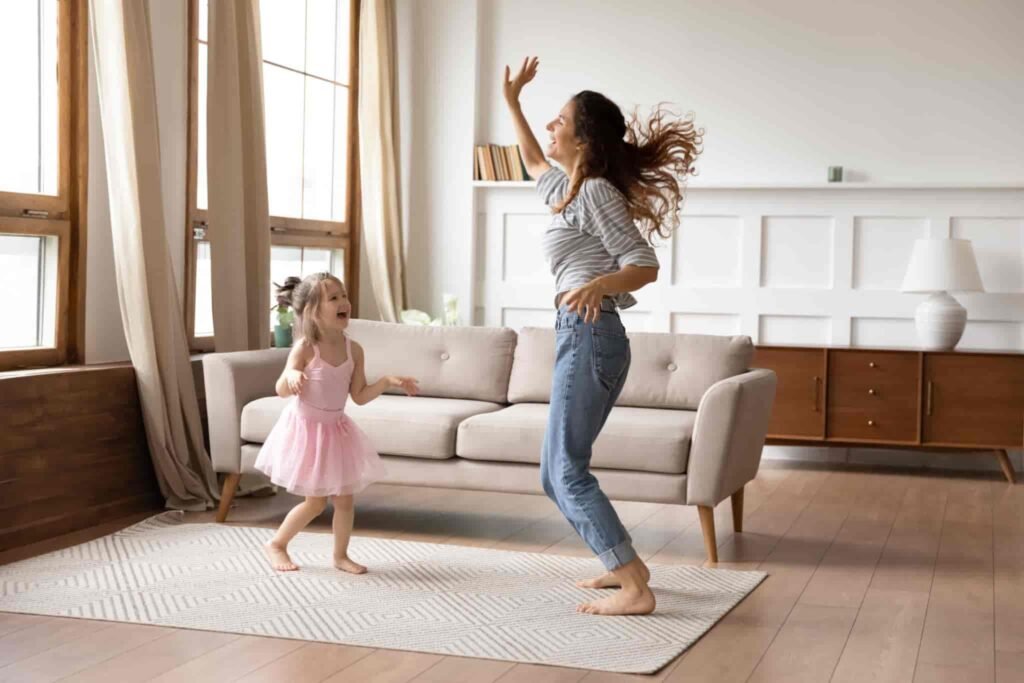
Songs with repeated words can also expose children to language patterns and familiar vocabulary.
How to make it more interesting
Sing about everyday routines, such as washing hands, getting dressed, or tidying toys. You can invent a song about your toddler’s favourite animal or use familiar nursery rhymes.
If you use recorded music, play audio without needing to show a video. Keep the volume comfortable and leave enough space for safe movement.
Avoid encouraging toddlers to jump from furniture or spin on slippery floors. Stop the activity if your child becomes overstimulated or tired.
Parent tip: A five-minute dance break can help change the mood of the afternoon without requiring you to set up another activity.
Activity 13: Match Large Objects and Containers
Best for: Toddlers who enjoy fitting objects together and putting things away.
What you need:
- A few large, toddler-safe containers
- Large objects that fit easily inside them
- A clear floor or table space
Many toddlers enjoy putting things into containers, taking them out, and repeating the process. You can turn this natural interest into a simple matching game.
Offer a few large, safe objects and two or three open containers. Demonstrate placing one object into a container, then invite your child to try.
You could use large toy blocks and a wide basket, large plastic cups and a bowl, or a few soft toys and a box.
Avoid objects that are small enough to fit entirely in your toddler’s mouth, as well as objects with sharp edges, detachable parts, or other hazards.
What your toddler may learn
This activity gives children opportunities to explore size, shape, space, and cause and effect. It may also encourage concentration and simple problem-solving.
You can introduce language naturally: “The ball is inside,” “The block is too big for that cup,” or “Let’s put the toys in the basket.”
How to make it more interesting
Offer containers of different sizes and allow your toddler to discover which objects fit. You can also turn the activity into a tidy-up game by putting toys away together.
Do not worry if your child empties every container as soon as you fill it. Repeating the action may be part of what makes the activity enjoyable.
Parent tip: This is a useful activity to try when you need something simple and quiet. Keep the number of objects small so the play area does not become overwhelming.
Activity 14: Create a Mini Pretend Grocery Shop
Best for: Toddlers who enjoy imitation, everyday routines, and carrying objects.
What you need:
- A few large toy food items or safe household pretend-play objects
- A basket
- A low, stable surface to act as a counter
A pretend shop can turn ordinary objects into a simple imaginative game. Arrange a few large toy foods on a low surface and invite your toddler to choose what they would like to buy.
You can take turns being the shopkeeper and the customer. For example, you might say, “Hello! Would you like an apple?” Your toddler can hand you a toy item, put it into the basket, or choose something else.
You do not need pretend money or complicated rules. For toddlers, the enjoyable part may simply be choosing, carrying, and exchanging objects.
What your toddler may learn
Pretend shopping offers opportunities to practise social interaction, communication, categorisation, and familiar routines.
You can also introduce words related to food, colours, quantity, and polite greetings.
How to make it more interesting
Use large toy foods or pictures securely attached to a board. You could also make a simple pretend fruit shop using safe play materials.
If your toddler enjoys the activity, let them decide what the shop sells. One day it may sell fruit; another day it may become a shop for toy animals.
Avoid using real coins, small food pieces, plastic packaging, or objects that could cause choking. Keep the play area separate from kitchen appliances and other hazards.
Parent tip: A pretend shop can naturally connect with your child’s everyday experiences without requiring a special toy set.
Activity 15: Try a Simple Family Storytelling Game
Best for: Toddlers who enjoy pictures, familiar people, animals, and pretend stories.
What you need:
- A few familiar toys or stuffed animals
- A comfortable place to sit
- Optional picture cards or sturdy picture books
Storytelling can be a lovely way to end a busy day. You do not need to remember a long story or read from a book. You can make up a simple story about a teddy bear, a trip to the park, or a toy that needs to find its home.
Begin with one character and one small event. For example, “Teddy wanted to go outside. Where should Teddy go?” Your toddler may point toward the door, choose a toy car, or suggest a place with a word or gesture.
If your child does not respond, continue the story yourself. The purpose is to share an enjoyable moment, not to test language skills.
What your toddler may learn
Storytelling provides opportunities to listen, imitate, use words, recognise familiar experiences, and explore simple sequences of events.
It can also encourage imagination and shared attention.
How to make it more interesting
Use a stuffed animal to act out the story. Teddy might look for a snack, visit a friend, take a bath, or get ready for bed.
You can also let your toddler choose the next action: “Should Teddy sit down or go for a walk?” Offer only a couple of options if too many choices become confusing.
Keep the story gentle and age-appropriate. If your child becomes restless, shorten it or move on to another activity.
Parent tip: Familiar stories can be repeated many times. Toddlers often enjoy knowing what happens next.
How to Choose the Right Screen-Free Activity for Your Toddler
With 15 activities to choose from, you might wonder where to begin. The easiest approach is to consider your toddler’s mood, energy level, interests, and the time you have available.
An activity does not need to last for a long time to be worthwhile. Some children will spend several minutes stacking blocks, while others will switch from one toy to another. Both can be part of normal play.
For quiet mornings
If your toddler has just woken up or seems content to sit and explore, try picture books, large blocks, crayons, or pretend play.
These activities can fit into a slower part of the day and do not require a lot of physical movement.
For energetic afternoons
If your toddler has been indoors for a while and seems restless, try a music break, a safe floor-based movement path, or a toy treasure hunt.
Make sure the play area is clear and that the activity matches your child’s balance and coordination abilities.
For busy parents
If you need to prepare a meal or complete a short household task, choose an activity you can supervise safely from nearby.
Sorting clean laundry, looking at sturdy picture books, or playing with large blocks may work for some children. However, water play and eating activities require particularly close supervision and are not suitable for situations where your attention must be elsewhere.
Never rely on an activity to keep a toddler safe while you leave the room or become absorbed in work.
For toddlers who get bored quickly
Offer fewer toys at a time and rotate the available activities occasionally. You can also change the purpose of a familiar object.
For example, large blocks can become a tower one day and a pretend garage the next. A basket can hold laundry, toys, or large pretend food items.
If your child loses interest, you do not have to persuade them to continue. Try something else or allow a break.
How to Encourage Independent Play Without Pressure
Many parents would love to have a few uninterrupted minutes to finish a task while their toddler plays nearby. Independent play can be encouraged gradually, but it is not a skill that every child develops at the same pace.
A toddler may need an adult to help begin an activity before exploring it independently. Another child may prefer frequent check-ins.
Here are some practical ways to encourage independent play.
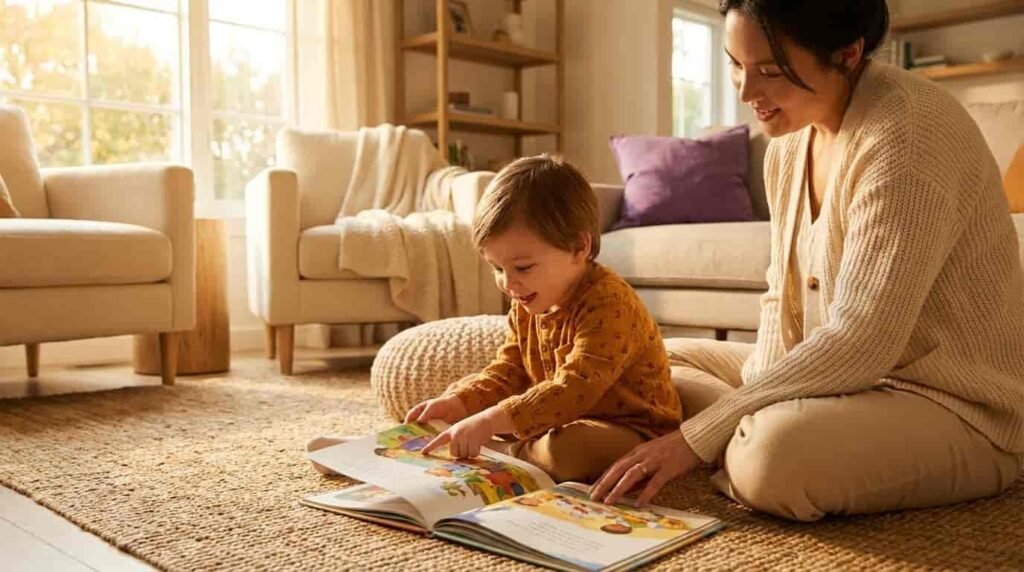
Start by playing together
Sit with your toddler and show them how the activity works. If you are using blocks, build a small tower. If you are playing with toy animals, show how the animals can be placed in a basket.
After a short time, reduce your involvement. You might say, “You can add another block,” then allow your child to decide what happens next.
Keep the play space simple
A large collection of toys can sometimes make it harder for a toddler to choose what to do. Try offering a small selection of safe, familiar objects.
You can rotate the selection every few days or whenever your child seems ready for something different.
Stay available
Independent play does not mean leaving a toddler unsupervised. Stay close enough to respond to your child’s needs and intervene if something becomes unsafe.
You can acknowledge your child’s efforts without directing every action. A simple comment such as “You are working on your tower” may be enough.
Respect your toddler’s limits
If your child becomes upset, tired, hungry, or frustrated, it may be time for a change. Young children need reassurance and connection as well as opportunities to explore independently.
Avoid using another child’s play habits as a standard for your own toddler. Development, temperament, and daily circumstances vary.
A Simple Screen-Free Daily Routine for Toddlers
You do not need to schedule every minute of your toddler’s day. A flexible routine can provide structure while leaving room for spontaneous play, meals, rest, and family responsibilities.
The following example is a starting point, not a strict timetable. Adjust it to your child’s sleep needs, childcare arrangements, and usual routine.
Morning: After breakfast, spend a few minutes reading a picture book or building with blocks. If your toddler enjoys helping, invite them to participate in a simple household task.
Late morning: Offer outdoor time when possible. If you are staying indoors, try a movement game or a treasure hunt using large toys.
Around lunchtime: Let your toddler observe or help with a safe, simple food-preparation task. Sit together for the meal and allow enough time for eating without unnecessary pressure.
After rest time: Try crayons, pretend play, or a toy animal game. A quiet activity may be helpful if your child is tired after a nap.
Late afternoon: Choose a music break, large-box play, or a pretend grocery shop. Follow your child’s interest and stop before the activity becomes frustrating.
Evening: Share a book, tell a short story, or include your toddler in a simple part of the bedtime routine.
The exact timing is less important than creating a balance of movement, quiet play, interaction, meals, and rest.
Some days will go smoothly; other days will be interrupted by errands, work, illness, or changing moods. A flexible routine should support family life, not create another source of pressure.
Screen-Free Activities for Toddlers When You Work From Home
Working from home with a toddler can be challenging because young children need supervision, attention, and frequent changes of activity. No collection of toys can reliably keep every toddler occupied for an entire work meeting or a full working day.
However, a little preparation may help during short periods when you can remain nearby.
Prepare a few activity baskets
Create two or three small baskets containing age-appropriate toys or materials. One might contain large blocks, another sturdy picture books, and another large toy animals.
Offer one basket at a time rather than presenting everything at once.
Keep small parts, plastic bags, batteries, magnets, cords, and other hazards out of reach. Check that every item is suitable for your child’s age and abilities.
Use activities that fit your availability
If you need to answer a short email, a familiar book or a safe set of large blocks may be appropriate while you remain nearby.
If a task requires your full attention, arrange suitable adult supervision instead of relying on your toddler to stay occupied.
Do not use water play, food preparation, or other activities requiring continuous close attention while you are working on something that prevents you from supervising properly.
Make transitions predictable
Toddlers may find it easier to move between activities when they have a simple idea of what comes next.
You might say, “First we will put the blocks away, and then we will have lunch.” Use simple words and allow time for your child to respond.
Some transitions will still be difficult. Offer reassurance and avoid expecting your toddler to switch activities immediately every time.
Include short moments of connection
A few minutes of shared play before beginning a task may help your toddler feel connected to you. Sit together, read a book, or build a small tower before explaining that you need to complete a short task nearby.
Your toddler may still interrupt you. This does not mean you have failed to establish a routine; it reflects the reality of caring for a young child.
If possible, coordinate childcare, partner support, or other help during periods when uninterrupted work is essential.
Common Mistakes to Avoid During Toddler Playtime
Screen-free activities should make family life more enjoyable, not become another set of expectations for parents.
Expecting every activity to last a long time
Toddlers often move quickly between interests. If your child plays with blocks for three minutes and then wants to look at a book, that is not necessarily a problem.
Offer variety, follow your child’s interests, and allow activities to end naturally.
Making every activity educational
It is tempting to turn every game into a lesson about colours, numbers, shapes, or letters. However, toddlers also need opportunities to explore without constant questions or instructions.
Let your child decide what to do with safe materials. You can add a few words or demonstrate an idea without directing every moment.
Comparing your toddler with other children
Children differ in their interests, energy levels, temperament, communication, and play preferences. One toddler may love drawing, while another prefers moving objects between containers.
Choose activities that suit your child rather than assuming that everyone should enjoy the same games.
Buying too many toys
You do not need to purchase a new product for every activity. Large blocks, sturdy books, suitable household containers, and a few favourite toys may offer plenty of possibilities.
When choosing toys, check the manufacturer’s age recommendations, inspect them for damage, and avoid small pieces or loose parts that could cause choking.
Using activities as a substitute for supervision
Even familiar toys can become unsafe if they break or are used in an unexpected way. Stay close, check the environment, and supervise according to the activity and your child’s developmental abilities.
Never leave a toddler alone near water, food that presents choking risks, household appliances, stairs, or other hazards.
Feeling guilty when you use screens
There may be times when a screen is part of your family’s routine. A video call with relatives, a practical digital task, or an occasional programme does not mean you have failed as a parent.
Follow current age-appropriate screen guidance from trusted health organisations, choose content carefully, and make room for sleep, physical activity, conversation, and hands-on play.
The goal is a healthy balance, not perfection.
Safety Tips for Screen-Free Activities at Home
Before beginning any activity, take a moment to check the environment. Toddlers are curious and may use an object in a way an adult did not anticipate.
Keep these precautions in mind:
- Prevent choking: Avoid small toys, loose parts, coins, buttons, beads, marbles, and other objects that could fit in a young child’s mouth. Be particularly cautious if your toddler still mouths objects.
- Supervise water activities: Stay within arm’s reach during water play and empty containers immediately afterwards.
- Prepare food safely: An adult should handle knives, hot surfaces, cooking appliances, and food preparation that requires cutting. Prepare food in forms appropriate for your child’s eating abilities.
- Choose suitable art materials: Use age-appropriate, non-toxic supplies and supervise their use.
- Secure the environment: Keep furniture stable, block access to stairs and unsafe areas, and remove cords and other hazards from the play space.
- Inspect toys: Check for cracks, sharp edges, loose pieces, damaged batteries, and other potential hazards.
- Watch for allergies and sensitivities: If an activity involves food or a material your child has not used before, consider known allergies and follow any relevant medical advice.
- Follow your child’s cues: Stop if your toddler becomes distressed, tired, or uncomfortable.
If you are uncertain whether a material or activity is suitable for your child’s age, choose a simpler alternative. Safety matters more than completing a particular game.
If you’re looking for more practical ideas to make mealtimes easier, explore our guide to Why Is My Toddler Suddenly Refusing Food? 10 Reasons and What Parents Can Do for simple snack ideas your little one may enjoy.
Frequently Asked Questions About Screen-Free Activities for Toddlers
1. What are the best screen-free activities for toddlers at home?
Some useful options include building with large blocks, reading picture books, pretend play, drawing with toddler-safe crayons, sorting laundry, dancing, and creating simple treasure hunts.
The best activity depends on your child’s interests, abilities, mood, and the space available. Start with one simple idea and adjust it according to your toddler’s response.
2. How can I keep my toddler busy without a phone or television?
Offer a small selection of safe, engaging materials and let your toddler explore them. You might begin with blocks, a picture book, large toy animals, or a pretend-play activity.
Try alternating quieter activities with movement and include short periods of shared play. Remember that young toddlers still need supervision and may seek frequent attention.
3. How long should a toddler play with one activity?
There is no single duration that works for every toddler or every activity. Some children may remain interested for several minutes, while others may switch between toys more frequently.
Rather than requiring a fixed period, observe your child’s interest. Offer a change when they seem bored or frustrated and allow them to return to a favourite activity later.
4. Are screen-free activities better than educational videos?
Hands-on play and real-world interaction offer opportunities for movement, exploration, conversation, and social connection. Educational videos may also have a place in family life when chosen appropriately, but they do not replace all the experiences children gain through physical play and interaction.
For guidance on screen use, consult current recommendations from your child’s healthcare provider or a trusted public health organisation.
5. What can I do when my toddler gets bored with every toy?
Try putting away some toys and offering a smaller selection. You can also change how a familiar object is used. Large blocks might become a garage, a basket might become a pretend shop, and stuffed animals might become characters in a story.
Sometimes, your toddler may simply need movement, rest, a snack, or connection with an adult rather than another new activity.
6. How can I encourage independent play?
Begin by playing alongside your toddler and showing them how an activity works. Gradually reduce your involvement while remaining available and supervising.
Keep expectations realistic. Independent play develops at different rates, and some toddlers need more reassurance than others. Avoid forcing long periods of solitary play.
7. What are some screen-free activities for toddlers when it rains?
Rainy days are ideal for indoor options such as large-block building, picture books, pretend tea parties, toy animal games, drawing, cardboard-box play, and simple movement activities.
Choose activities that fit the available space and keep pathways clear. If your toddler needs to move, try a safe floor-based game rather than encouraging climbing on furniture.
8. Can household chores become screen-free activities?
Yes. Toddlers may enjoy helping sort clean laundry, placing large toys into a basket, or participating in a simple food-preparation task.
Choose tasks that are appropriate for your child’s abilities and supervise closely. Keep detergents, sharp tools, hot surfaces, electrical appliances, and small objects inaccessible.
9. Do I need expensive toys to support my toddler’s development?
No. You can offer a range of experiences using simple, safe materials, including large blocks, sturdy books, suitable containers, washable crayons, and familiar toys.
Choose materials carefully and remember that your toddler’s interest and the opportunities for exploration matter more than the price of a toy.
10. What if my toddler refuses to participate in an activity?
Do not force it. Your child may be tired, hungry, overstimulated, or simply uninterested in that particular game.
Offer another choice or try the activity on a different day. If you have concerns about your child’s development, communication, movement, or play, discuss them with a qualified healthcare professional.
Final Thoughts: Make Screen-Free Play Simple and Enjoyable
Finding screen-free activities for toddlers does not have to mean creating elaborate crafts, buying expensive toys, or planning every hour of the day.
A few large blocks, a favourite picture book, a pretend tea party, or a simple game of finding toys can provide opportunities for exploration and connection. Everyday routines, such as sorting laundry or helping with a safe part of snack preparation, can also become enjoyable experiences.
The most important thing is to choose activities that suit your toddler’s age, interests, and abilities. Keep play flexible, allow your child to explore at their own pace, and remember that activities do not need to last a long time to be worthwhile.
You do not have to entertain your toddler every minute. Children benefit from a balance of shared interaction, safe exploration, movement, rest, and opportunities to practise doing things for themselves.
Some days, your toddler may spend a happy stretch building a tower. On other days, they may move from one activity to another in just a few minutes. Both kinds of days can be part of family life.
Start with one or two ideas from this list, notice what your child enjoys, and build from there. Over time, you may discover that the simplest activities become your toddler’s favourites.
A gentle reminder for parents: You do not need to create a perfect play environment. Your attention, patience, and willingness to let your child explore are valuable parts of everyday learning.
Disclaimer: This article provides general parenting information and is not a substitute for individual medical or developmental advice. Choose activities appropriate for your child’s age and abilities, supervise closely, and speak with a qualified healthcare professional if you have concerns about your toddler’s development or safety.